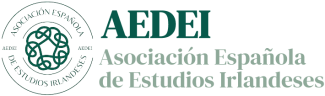

It is a great honor for me, Auxiliadora Pérez Vides, to address you as the newly elected President of the Association. I am truly pleased and grateful to the members for their trust and support.
Our dear association treasures a long history of promoting Irish culture, language, literature, music and history in Spain, which we celebrated recently in our 24th annual conference, in Vitoria-Gasteiz.
I take this occassion to show my deepest appreciation to the former Presidents, Inés Praga-Terente, Marisol Morales-Ladrón, Asier Altuna-García-de-Salazar and Pilar Villar-Argáiz, as well as the previous and current members of the Executive Board. Their generous dedication, vision, and hard work have built a strong and lasting legacy that has genuinely shaped AEDEI.
We have also achieved a great positioning of our journal Estudios Irlandeses, thanks to all its editorial teams. I would like to convey my heartfelt gratitude and admiration to them for contributing to such a prestigious academic standing.
A special mention also to all the colleagues from universities and centres all over Spain whose professional rigour and human quality have not only made AEDEI a space of scholarly exchange but also a distinctively welcoming and friendly place.
In this new chapter, our goal is to continue building upon this strong foundation. Together, we will expand our academic reach, support early-career scholars, and strengthen our national and international connections. For that, we will continue caring for our members and activities, and will warmly welcome individuals interested in Ireland and its rich and varied cultural productions. Do not hesitate to get in touch with us.
I look forward to working closely with all the AEDEI community to consolidate the vibrancy of Irish Studies and to contribute to its even more vibrant future.
The Spanish Association for Irish Studies (AEDEI) brings together professors, lecturers, students and others who share an interest in all aspects related to the history, society, art and literature of Ireland. It is a non-profit academic organization devoted to the appreciation and promotion of Irish culture in Spain.
AEDEI was founded at the University of Burgos in 2001 by Prof. Inés Praga, who was its first president and is now its honorary chairperson. Since its founding, AEDEI has expanded enormously, covering a great number of people working in the area of Irish Studies. The AEDEI annual meetings, which normally take place in May at a Spanish university, provide an opportunity for members to meet and exchange information. Membership can be secured by sending a message to the secretary.
Estudios Irlandeses is the AEDEI journal, a dynamic and specialized e-journal published once a year with contributions from scholars all over the world. Estudios Irlandeses aims to address an ample range of issues related to Irish studies and it has already become an international forum for original research in the field.
Foreword by Inés Praga Terente
Honorary Person of the Spanish Association for Irish Studies
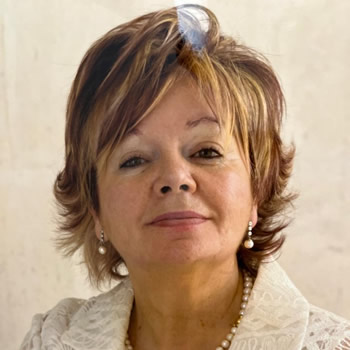
In late May of 2001 the Spanish Association for Irish Studies (AEDEI) was founded in Burgos by a group of enthusiastic academics who gathered there on three sunny and unforgettable days. The opening session took place with the presence of the Irish ambassador, the president of the university and the mayor of the city, all of them witnessing the historical moment. It was then that our association was created but it is evident that it was not born from scratch but built on some previous pillars. In Spanish universities Irish literature, history or culture were traditionally concealed into subjects such as “Literatura Inglesa” or “Cultura y Civilización Británicas”; nonetheless in the last decades important efforts were made to hold “cells of resistance” by creating Irish panels in national and international associations, promoting research projects, supervising Ph.D. dissertations and contributing with seminal books and essays. In addition, there existed some sort of oral tradition -in the most genuine Irish way- that made up for the lack of academic recognition, the lack of “a room of our own” in the Spanish university premises. A good number of us began to discover Ireland by chance, fate or simply by a random Erasmus programme that provided the younger generations with the “Irish opportunity”. All these factors -chance, fate, exchanges- generated a vivid dynamics of story telling in which people shared wonders about their stays in Ireland and passed on enthusiasm, encouragement.
It is not easy to defend the idea of an association in the Internet times. Communication has never been so fast nor has so much information been available to us. Nonetheless, nothing can replace an association that intends to be a true meeting point, a sort of watchtower from which all of us can look at Ireland both individual and collectively, a kind of crossroads of experiences.
We all have shared the heritage of living Ireland from the distance -a frequent strategy in Irish history and culture- and we are aware that in many ways the idea of Ireland -or Irelands, to be more exact- and what it represents to those who live there has been imagined by those who live far away from her. So the young Spanish Association for Irish Studies aims at creating an academic community in which we can contrast viewpoints and unify resources, strength, experiences and expertise.
Much is being talked about the current worldwide “hibernization” and our role as an association -should it be defined- would be to help understand the complexity of “Irishness”, which means a long and tough task. In other words, to offer the Spanish response to the wide range of discourses Ireland is writing at present. At the beginning of this millennium Ireland has become a shifting landscape which demands from us the acknowledgement of difference, hybridity and cultural mixing and in which facts like immigration or the peace process, among others, are to provide us with unknown meanings of the term “Irish”. So far the results have been eighteenth International Conferences and nine volumes based on them: Praga Terente, Ines (ed) Irlanda Ante un Nuevo Milenio (Burgos 2002), González Rosa (ed) The Representation of Ireland/s (Barcelona 2003), Fernandez and Jaime (eds) Irish Landscapes (Almeria 2004), Trainor and Krauel (eds) Humour and Tragedy in Ireland (Málaga 2005), Altuna and Andreu (eds) Re-writing Boundaries (Barcelona 2007), Carrera et al (eds) The Irish Knot (Valladolid 2008), Clark and Jarazo (eds) In the Wake of the Tiger and To Banish Ghost and Goblin (Coruña 2010) and Morales Ladrón and Elices Agudo (eds) Glocal Ireland (Newcastle 2011), Oliva (guest ed) Revista Canaria de Estudios Ingleses. Special Issue. Other Irelands: Revisited, Reinvented, Rewritten (La Laguna, 2014), González Arias (ed) National Identities and Imperfections in Contemporary Irish Literature: Unbecoming Irishness (London, 2016), Losada Friend, Perez-Vides & Ron Vaz (eds) Words of Crisis, Crisis of Words: Ireland and the Representation of Critical Times (Cambridge, 2016), Altuna García de Salazar (ed) Ireland and Dysfunction. Critical Explorations in Literature and Film (Newcastle, 2017), “Voice and Discourse in the Irish Context” Villanueva Romero, Amador-Moreno & Sánchez García (eds.) (London, 2018), Villar-Argáiz (ed) Nordic Irish Studies. Special Issue Discourses of Inclusion and Exclusion: Artistic Renderings of Marginal Identities in Ireland (Dalarna, 2016) and Irishness on the Margins: Minority and Dissident Identities (New York and London, 2018), Terrazas (ed) Gender Issues in Contemporary Irish Literature (Almería, 2018) and Trauma and Identity in Contemporary Irish Culture (Bern, 2020).
The 18th International Conference, that was held at the University of the Balearic Islands on 29 May – 1 June 2019, is the most recent landmark of our long and marvellous pilgrimage to which all of you are welcome.